
This post contains spoilers. You’ve been warned.
Happy Halloween!
A chill entered the air, leaves changed their greens into golds, and reds, and ochres, pumpkins are spiced, and spooky season is upon us.
The wisps of steam from my tea infuse into the crisp air and I know: it’s officially time for horror movies. Halloween is my favourite time of year and in my house, it lasts from mid-October to mid-November. I must admit that I am a horror-all-year kind of girl, but there’s something special about Halloween that makes it feel right.
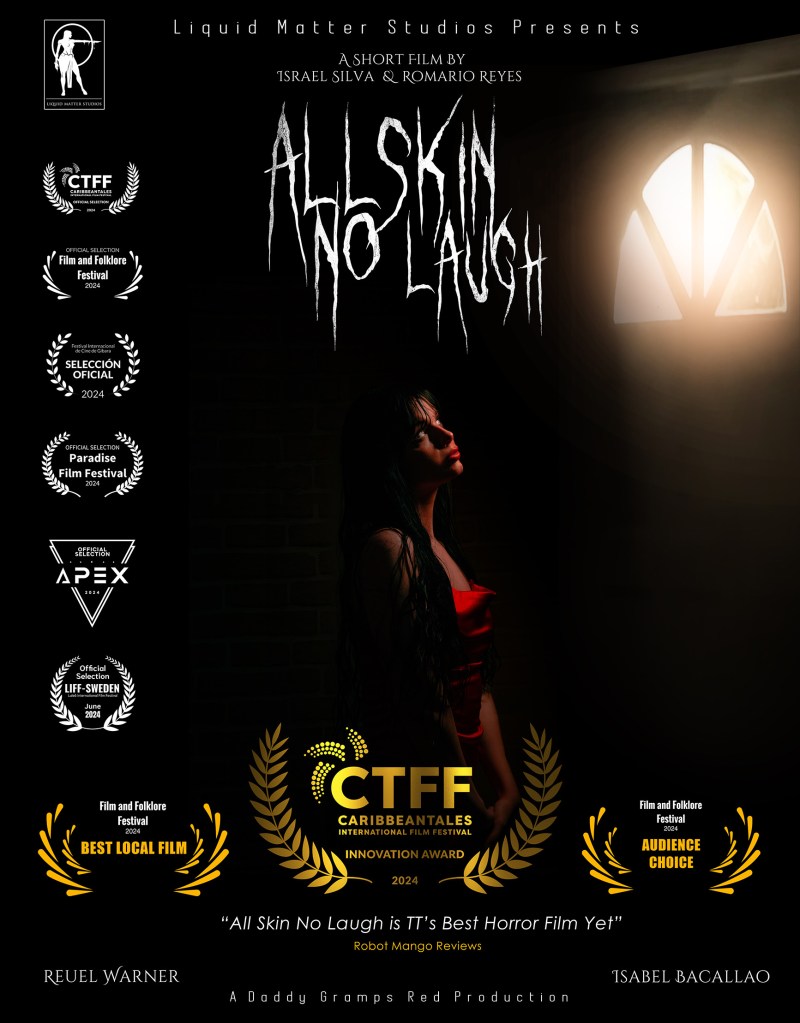
This spooky season, one haunting story was a spectre on my mind. All Skin No Laugh is an award-winning Caribbean short film co-directed by Israel Silva and Romario Reyes. It was produced, scripted, and filmed by the same iconic family that created Short Drop.
I was fortunate enough to sit down in conversation with Israel Silva, Romario Reyes, and Mary-Rebekah Reyes to discuss All Skin No Laugh (ASNL) fresh from their win of the Audience Award and Best Local Film at the Film and Folklore Festival, and the Innovator Award at the Caribbean Tales Film Festival.
There were so many stunning moments in this film. In a similar fashion to Short Drop, ASNL was well thought out, scrupulously planned, and laden with easter eggs. As the resident English Major/Swiftie in my family, it should be known that easter eggs are everything to me.
Silva and Reyes made the decision early on to include many subtle moments to create layers and textures for the rewatch. A feast for the mind.
Silva commented on the presence of easter eggs nestled into both the imagery and the script.
“Romario and I really love subtext in movies. Matrix had a big impact in my life because Matrix has a ton of subtext. It makes you rewatch something over and over and over because you want to understand exactly what the director’s going for or what the writers are going for. So we tried to implement that. You can see it in Short Drop too, but we tried to implement even more of that in this one.”
The first thing I noticed about the film was the atmosphere; the heavy rain, the long pan of the front door, the darkness, the suspense. It started in a place of unease.
From the second we enter the house, it’s a normal evening for our main character, Omari, played by Reuel Warner, playing video games with his friends online. The rain thunders against the house until the power cuts. With a trademark steups he texts his friend, messaging about T&Tec, which for any Trini is a good laugh to break the tension because of course it’s T&Tec responsible for the blackout.
I felt immense tension despite not much going on besides the blackout. Omari is, naturally, annoyed that his gaming session is cut short, and we are left in the dark with nothing but thundering rain. But only for a moment. A blink in time.
Even in those first few minutes of the film, there are so many strong art references that reflect the essence of the story. Omari’s screensaver is a closeup of a famous Renaissance fresco painting called Predicazione dell’Anticristo (The Preaching of the Antichrist) by Signorelli. The background of the WhatsApp chat, a woman removing a wooden mask from her face, is a piece called Deception by Jen Coffey. There were two paintings by the Reyes’ fathers: Stuart Reyes’ The Crucifixion, and Avellino Ken Reyes‘ Writin’ on de Wall which features a spray painted wall inscribed with “mene, mene, tekel, upharsin,” an Aramaic phrase referring to the feast of Balthazar in the Book of Daniel that roughly translates to “numbered, numbered, weighed, divided.”
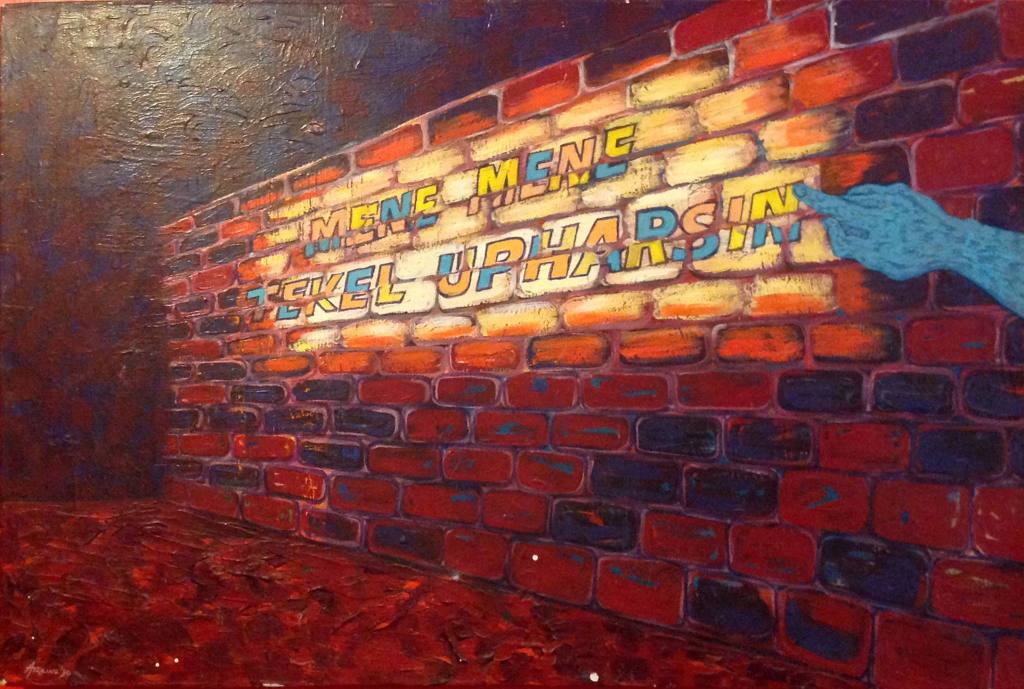
Avellino Ken Reyes ‘Mene Mene Tekel Upharsin”
Acrylic on Canvas. 1994. The title painting for the ‘Writin on de Wall’ series.
“In that short [ASNL], we wanted the audience and the protagonist to pay attention to the signs and subtext around him, maybe he will be able to escape the fate around him,” Silva said. “I put that [deception] as the WhatsApp background because I knew that people would pay more attention to the messages rather than the image.”
And pay attention to the messages I did. Omari decides to grab some water. But I’ve never been so anxious watching someone get water. The shots from inside the fridge were maddening, like I was a forgotten bottle sitting in the back watching, waiting for something to happen in the midst of all the rain and annoyance. The ambiance is right, the artwork created a sensation of something, and I’m left on the edge of my seat waiting for…
Knock, knock, knock.
I jumped.
A Latina stands on the porch, soaked in rain water, calling out in the middle of the night. Omari looks out into the night and spies Amaya, played by Isabel Bacallao, who becomes the momentum we were waiting for. Amaya’s car has been attacked at gun point. She is scared, without shoes, she left her purse, phone, and wallet with the gunman, and needs to call her sister.
This scene depicts a lot about Trinidadian society. Unfortunately, it is common to hear stories like this. Every country has crime, and Trinidad is no different. The types of crimes vary depending on the area, but it’s quite common to hear stories about people having their cars stolen at gunpoint along with everything else in the car. Crime has gone up along with gun violence, and often times vulnerable people and communities are targets of these attacks.
I was curious about the choice to cast a Latina actress. For those of you who are not Trini, there’s some context you may be missing. Over the past decade, there has been a massive influx of immigrants from Venezuela into Trinidad due to proximity (7 miles by sea) and the intensely declining quality of life inside Venezuela. “As of November 2023, approximately 44,800 Venezuelan migrants, refugees, and asylum seekers were living in Trinidad and Tobago,” according to ACAPS. This has rapidly changed social dynamics within the country. Some of the Venezuelans living in Trinidad do not have legal status in the country and are a particularly vulnerable population in our country.
Many refugees and asylum seekers risk their lives going through the Bocas del Dragón, very rocky ‘mouths’ to the open ocean that have high currents, to find safe harbour and instead, find difficulties when they arrive. The Bocas are known as dangerous to sail in, and as someone who’s done it on a clear blue day with little currents, I can attest to the dangers of daring even one Boca, let alone two. Many shipwrecks have been recorded in this area, and that number is increasing.
Besides the natural dangers, these Bocas are high traffic routes for all types of illegal activities including narco-trafficking, human trafficking, and piracy. If these asylum seekers make it to Trinidad, they are faced with potential deportation and discrimination on social, linguistic, and governmental levels. Even Amnesty International issued an article to plead for the Trinidadian government to stop deporting Venezuelan refugees and asylum seekers due to the dangers of being returned.
As a half-Venezuelan myself, I immediately understood when Omari’s friend referenced to her as “a Vene ting.” Despite Bacallao’s Cuban heritage, even I had to admit the physical similarities she shares with Venezuelans, as I’ve seen in my own family. I was interested in the choice to have Amaya identified in this group and Silva shed light on the larger purpose in the story.
“I kept trying to think from the perspective of the protagonist. If a Trini woman was to come up to my door at that hour of night, I would be way more suspicious of the individual because I know she’s Trini and she knows the place, she knows what street this is, she knows the area. Whereas if it’s a foreigner, and if it’s a Venezuelan, with the influx of Venezuelans that did come in, a lot of them are vulnerable, a lot of them would need help. It lends more to the story. As the protagonist, I would see why they would help this person,” Silva said.
I completely agreed with him. We even discussed times when local criminals would use women to approach people in their houses and cars to gain access before being robbed, and in some cases, killed. It’s a sad reality that being a good samaritan can lead to direct and extreme harm in these situations. I felt this was such an important way to view the characters. Including this storyline forced me to think about the current situation in Trinidad for both locals dealing with increasing violence and crime, and the vulnerable populations escaping a different type of political violence. I discovered the true horror: reality.
Once Amaya entered the scene, the tension rose and rose. She is a vulnerable person who has just been attacked. Omari invites her in, offers her a towel, a cup of tea, and the phone. She mentions that she likes the “Writin on de wall.” How could he not help this person?
We feel a different sort of tension now, leaning into the gender dynamics of the situation. The horror, reality, is that many vulnerable women face further harm when seeking assistance. It’s a sad truth, and one I wish wasn’t true. I felt worried about the situation. I was not thinking the worst of Omari until I read the messages coming in. But in truth, it was his friend that was the creep, not him.
One of my favourite moments from the film was so subtle, but also something so indicative of both genre and story. When Omari went to make tea for Amaya, there was a shot of us (the audience) as the spoon staring down into the whirlpool of tea. It reminded me of Get Out. The scene where the mom is hypnotizing the protagonist. It’s really the moment where you realize something has gone terribly, horribly wrong. In terms of the story, this is the point where everything goes sideways.
Omari has been a perfect gentleman. He invited Amaya inside, got her a towel, made her tea, and then handed her his phone.
Amaya calls her sister and then sees a text message from Omari’s friend. She instantly recognizes that she’s being sexualized, that she is being viewed as something to “smash.” After a particularly difficult night, I understood when she fled. Omari left the room, and came back to an open door and the sound of rain once more.
After Amaya leaves, Omari goes to sleep until the thudding of feet wakes him up. He sees dark footprints on the ground.
My favourite fact about these footsteps has little to do with the film and everything to do with the owner of them. Mary-Rebekah Reyes offered her services as more than a producer for this film, she offered the important role of footprint maker. Thank you for entering my nightmares and unearthing a new fear, Mary-Rebekah, I’d have it no other way.
Omari hears more footsteps. This time there is no rain, the footsteps sound like they’re crawling through the walls, climbing onto the roof, and thudding from the basement. It’s a surround-sound experience. I cannot deny I was clutching the collar of my hoodie and I kept saying, “stay in bed, don’t be stupid and investigate, stay in bed!”
But he didn’t.
Omari gets up and heads to see what is making that god awful noise.
The soundscape of this film added finesse. First with the rain, the metallic spoon sound, then the footsteps, and then what sounds like a nightmare score playing overtop cinematic effects that looked a little too real for my comfort.
When Omari turns back and looks down the stairs, I wish he hadn’t. The VFX work was truly art. I have not been scared like this in a very long time. The suspense of the film definitely hit its peak when the demon reveals itself. If you don’t believe me, watch it yourself. There’s a reason this film won so many awards.
At the end of the film, we come to realize that Omari experienced a premonition when he opened the door to Amaya. He felt the darkness around her, and was given protection by an omniscient force. In discussion with Silva and Reyes, I asked them about this decision. Silva said it was actually his younger brother, Luke, who suggested this idea as they had an entirely different ending planned. But sometimes, a suggestion goes a long way. It inspired the directing duo to take this concept and run with it.
“We were trying to find a way to leave it more open-ended and leave it that protagonist can survive or maybe he won’t, we don’t know,” Silva said.
Open-ended and bleeding out anxiety is exactly where the film drops off. I’ve always thought that the scariest things sit in the unknown, the abject. This is one of my favourite techniques in horror, to leave the audience with “what if?”
Silva mentioned in conversation that this open-endedness lends legitimacy to all the subtextual signs that run throughout the film, and I couldn’t disagree with him. From the paintings, to the massive snake tattoo on Amaya’s arm, to the hesitance Omari felt during the interaction, to the fact that, as Silva pointed out, she said “hermanas,” which means sisters — something that no one would say, in Spanish, to their sister. These signs and symbols lend a solidifying presence to this horror film, and allows believability within the absurdity of the situation.
This premonition works on a secondary level. In Caribbean culture, it is important to listen to your instincts. In certain circumstances, it can save your life. But premonitions and dreams are often a part of everyday life, not for everyone, but for many people living across the Caribbean. There is something powerful about including premonition here, something referential to the culture that founded this proverb-turned-film. By the end of the film, I didn’t know what to believe.
With conversations around the Venezuelan community now settling in Trinidad, it is important to acknowledge how vulnerable these people are in our society. I liked that Amaya was both vulnerable and dangerous, I liked that when you realize it’s a premonition that you aren’t sure if she was vulnerable at all. What can I say? I’m a sucker for a female villain.
All Skin No Laugh imagines the Trinidadian proverb “All skin teeth eh laugh.” You can’t trust everyone. This film made me want to trust no one.
I genuinely fell in love with this film for many reasons. I see myself and my interests reflected in so many ways. The artwork reflected the deception taking place, the soundscape created all the creepy crawly feels I look for in a horror movie, but most of all, I see my culture. It’s rare to see a film that deeply reflects hard-earned cultural values, and even rarer to find a film that shares those values and highlights a key issue that’s core to your identity.
You can’t trust everyone around you. Sometimes it’s those you trust first that end up stabbing you in the back. Sometimes, those who smile in your face also smile at your demise. Those people are the hardest to shake because they do the most damage. It’s truly horrifying. And with the state that our country faces with increases in violent crimes, and with the plight of many Venezuelan refugees and asylum seekers facing discrimination and violence, this film not only prolonged the importance of our proverbs, but created a lasting social stamp of where we are today.
The true horror is reality. That reality is that we can no longer trust one another, and maybe we never could.


 Poetry, Prose, & Peonies
Leave a reply to Dipping into Your Palette – Poetry, Prose, & Peonies Cancel reply